
Introduction
In a world where competition reigns supreme, and survival depends on navigating the relentless waves of change and the constant barrage of global developments, organizations of all sizes and types have no choice but to plan for their future and be highly prepared for unforeseen and often unpredictable circumstances.
The near-radical transformation the world has witnessed over the past two decades has rendered the factors and skills that once contributed to organizational success insufficient and unreliable for achieving success today. Management science has been, and remains, the true key to business progress and development, and the primary resource providing organizations with the solutions they need to address their challenges. However, unlike many other sciences characterized by stability, the only constant in management science is continuous change. Perhaps the most significant reason for this is that this field is directly affected by the variables and developments occurring in the environment. Technological, economic, social, political, and other changes have made management science a challenging, and sometimes complex, field that must adapt to all these emerging developments.
In this increasingly complex situation, we can ask:
What can management do to ensure that the organization remains on the right track in a changing environment, one characterized by often uncertain and unpredictable circumstances, many of which are beyond the organization’s control?
The prevailing belief that strategic management is the prerogative of large corporations is no longer valid in today’s business world. Global trends, shaped by the ever-increasing effects of globalization and technological advancement, have resulted in the fierce competition we witness today. This competition makes no distinction between small and large organizations; everyone is chasing the customer. Successful large organizations that adopt a strategic approach to management naturally possess the experience, resources, capabilities, and ultimately, the regulations of the World Trade Organization that enable them to operate and compete anywhere. This fact should serve as an urgent incentive for small and medium enterprises to adopt a strategic approach to management, which will reduce the impact of external forces and the threat of large companies, and enable them to survive and compete.
What is Strategic Management?
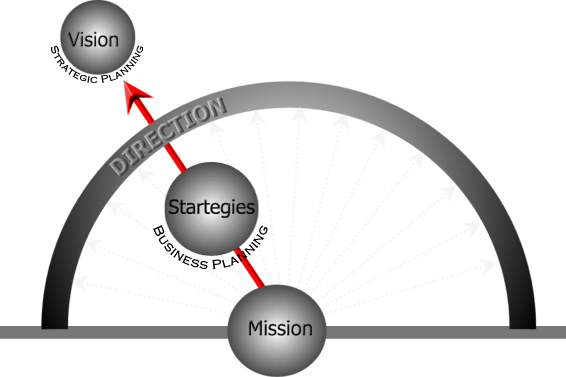
The term “strategic management” has been used since the 1970s, referring to the efforts of strategic planners within organizations that resulted in “strategic programs” presented to decision-makers for approval. Now, the concept has shifted from being simply “planning activities undertaken by employees” to a comprehensive management process adopted by senior management, which initiates the strategic direction of the organization. Clearly, most “strategic management” in the past involved strategic planning, to the point that the two terms were often used interchangeably.
While the concept of strategic planning has evolved from being a process where employees initiate strategic ideas and programs for management to adopt, to a process led by senior management that envisions the organization’s future and develops the processes, procedures, and resources necessary to achieve it, this concept, despite being a fundamental precursor to strategic management, is insufficient for the success of the strategic planning process and the organization’s attainment of its desired future. This requires the deployment, implementation, and evaluation of the resulting strategic plan to measure its progress and effectiveness in achieving its objectives. This is the essence of strategic management.
Therefore, strategic management can be defined as follows:
(It is the process of identifying and implementing the necessary changes and measuring the organization’s performance on its path toward achieving its desired future state, or “vision”).
Thus, strategic management links strategic planning and its accompanying decisions with operational management, which focuses on business activities, procedures, and daily operations. This necessitates integration, coordination, and alignment among all resources. The internal institutional functions and efforts to implement the organization’s strategies, and thus gain a competitive advantage, enable the organization to navigate all challenges, most notably competition, in order to achieve its vision.